

Nobody ignored the shower. Three people reported it and one worked on it. The chat did what a chat does: it showed the photo to everyone. A fault needs more than being seen. Go back to the morning and follow the report.
08:15Room 112
The photo goes out, and the sentence stays behind
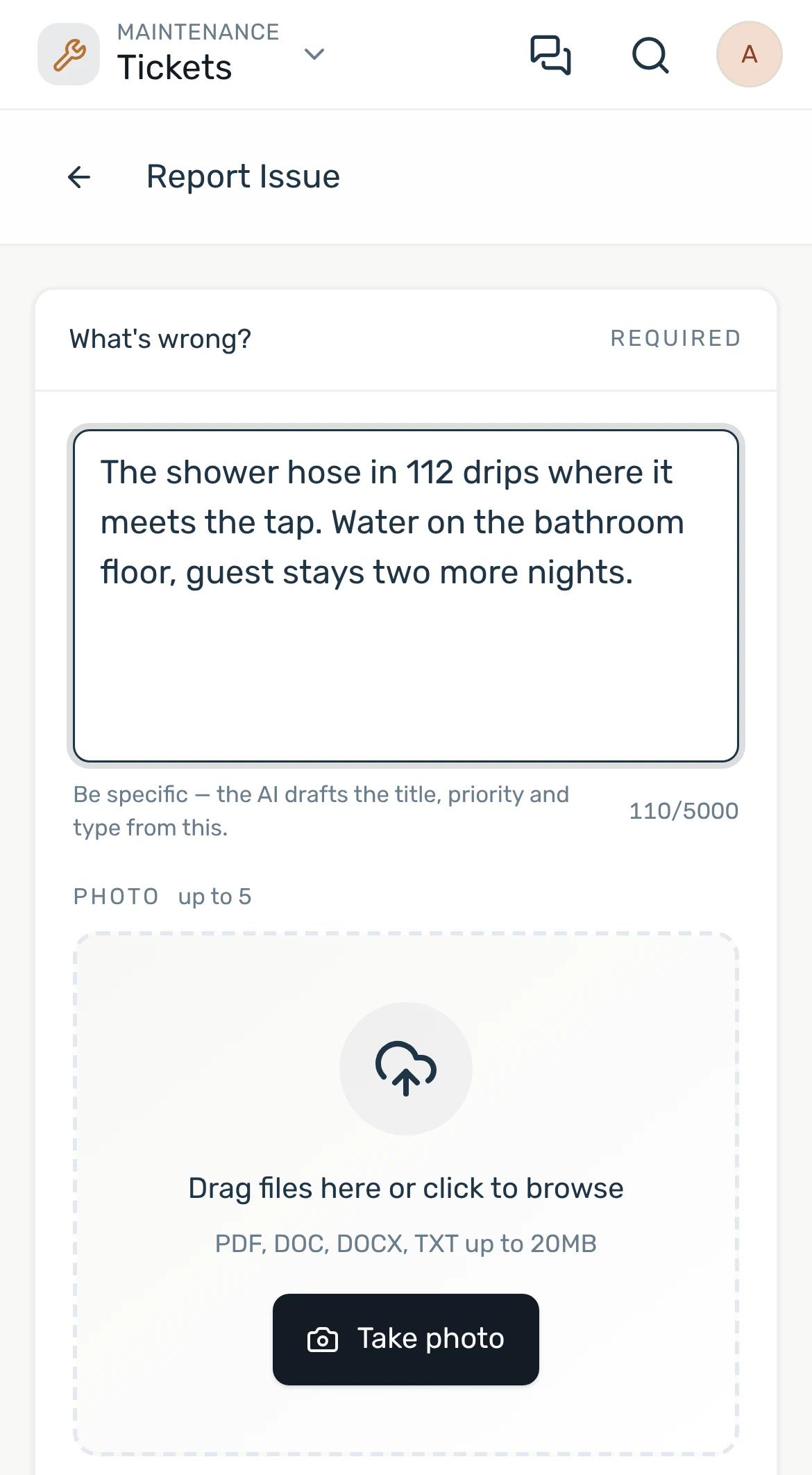
Marta is cleaning 112 while the guest is at breakfast. The shower hose drips where it meets the tap, and there is water on the floor. She takes a photo and posts it in the staff chat with two words: "112 shower".
She knows the guest is staying two more nights. That is not in the message.
Where it gets lost
The details. A photo shows that something is wrong. It does not say where exactly, how bad it is, or whether a guest is living with it.
How to close it
One sentence is the part nobody may skip. Ask for the same four things every time: what is wrong, which room, where exactly in the room, and a photo. A card on the housekeeping trolley is enough to make it a habit.
08:16Staff chat
Everyone sees it, and nobody takes it
Within a minute the photo has three thumbs up. Luca, the technician, is on the roof with the boiler and does not look at his phone. His colleague assumes Luca has it.
Nobody writes "mine". Nobody writes "by noon".
Where it gets lost
The owner and the deadline. A thumbs up means "seen". It does not mean "I will do it", and it never means "by when".
How to close it
Every report gets a name and a time within minutes, and "nobody yet" has to be visible too. Decide in advance who takes what: bathrooms to one person, kitchen to another.
11:20First-floor corridor
The same shower is reported again, twice
Dario brings fresh towels to 112, sees the water and posts his own photo. At 13:00 the guest mentions it to a waiter, who writes a third message.
Luca comes down from the roof and sees three messages. One shower, or three?
Where it gets lost
The count. Three reports of one fault look like three faults, or like one that someone has surely handled by now.
How to close it
Before you report, look at what is already open for that room. That only works if open faults live in one list sorted by room, not in a stream sorted by time. Add to the existing report instead of starting a new one.
14:05Room 112
The repair starts, and stops for a part
Luca goes to 112. The hose is fine; the fitting behind it is worn, and he has none in the workshop. He orders one for tomorrow morning and moves on to the next job.
In his head the shower is "waiting for the part". In the chat nothing has changed. Nobody asks whether the guest should be offered another room, because nobody knows there is a decision to make.
Where it gets lost
The status. In a chat, "not seen", "working on it" and "waiting for a part" all look the same: silence.
How to close it
Three states everyone can read without asking: open, in progress, resolved. Add a visible note when the job is waiting for a supplier, because that is when someone else has to decide about the room.
16:40Front desk
The guest asks, and the desk has nothing to say
Back to Sara. She calls Luca, who is in the cellar without signal. She calls housekeeping, who reported it at eight. Ten minutes later she knows what Luca knew at 14:05, and the guest is still standing there.
Where it gets lost
The answer. The person who reported the fault, and the person facing the guest, are the last to hear what happened to it.
How to close it
Whoever reports a fault should hear back without asking: taken, in progress, waiting, done. And the front desk needs to look up a room's open faults without a phone call.
Everyone saw the photo. Nobody had the job.
The same Tuesday, as one ticket
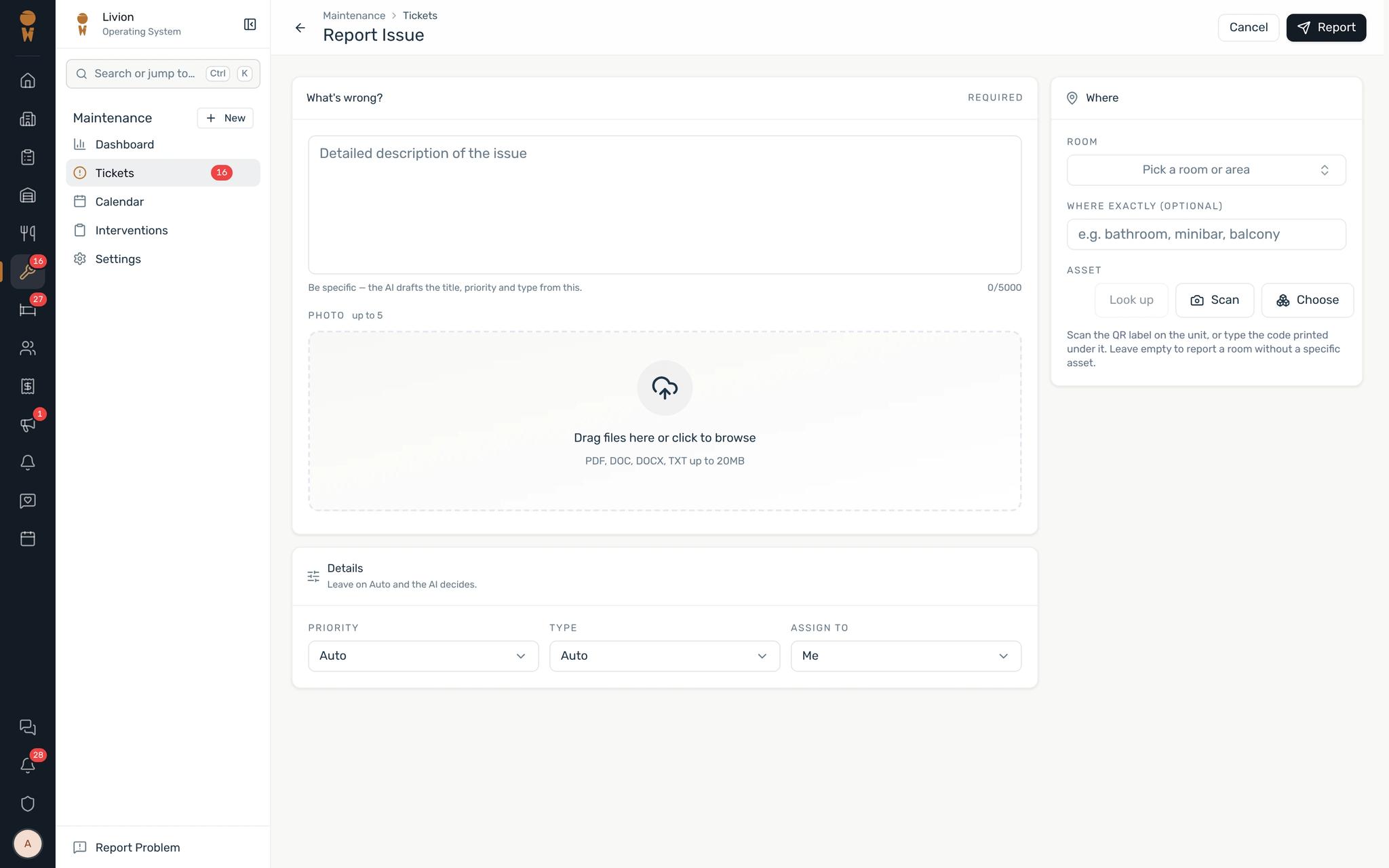
Livion is hotel operations software that works alongside your PMS. Its maintenance module turns the chat message into a ticket:
- Anyone on the team reports a fault from the phone with a photo and a sentence, and says which room and where exactly in it.
- Livion fills in the title and the priority and assigns the ticket to a technician.
- Before the report is filed, Livion shows open tickets that read like it, so the second person opens the existing ticket instead of creating a duplicate.
- Every ticket has a status, Open, In Progress or Resolved, and a deadline that follows its priority. While a ticket waits for a supplier, the clock is paused.
- The person who reported the fault is notified of every update and reply.
- The room can be taken off sale from the ticket, and comes back when the ticket is resolved.
Keep the chat for quick questions and a thank-you. Give faults a place where they have a name, a time and a status. Bring one week of your maintenance chat to a demo, and we will show you the same week as tickets in Livion.